

What Buyers Should Check in a Global Advanced Alkaline Electrolyser Supplier — Houpu on Integrated System Layout
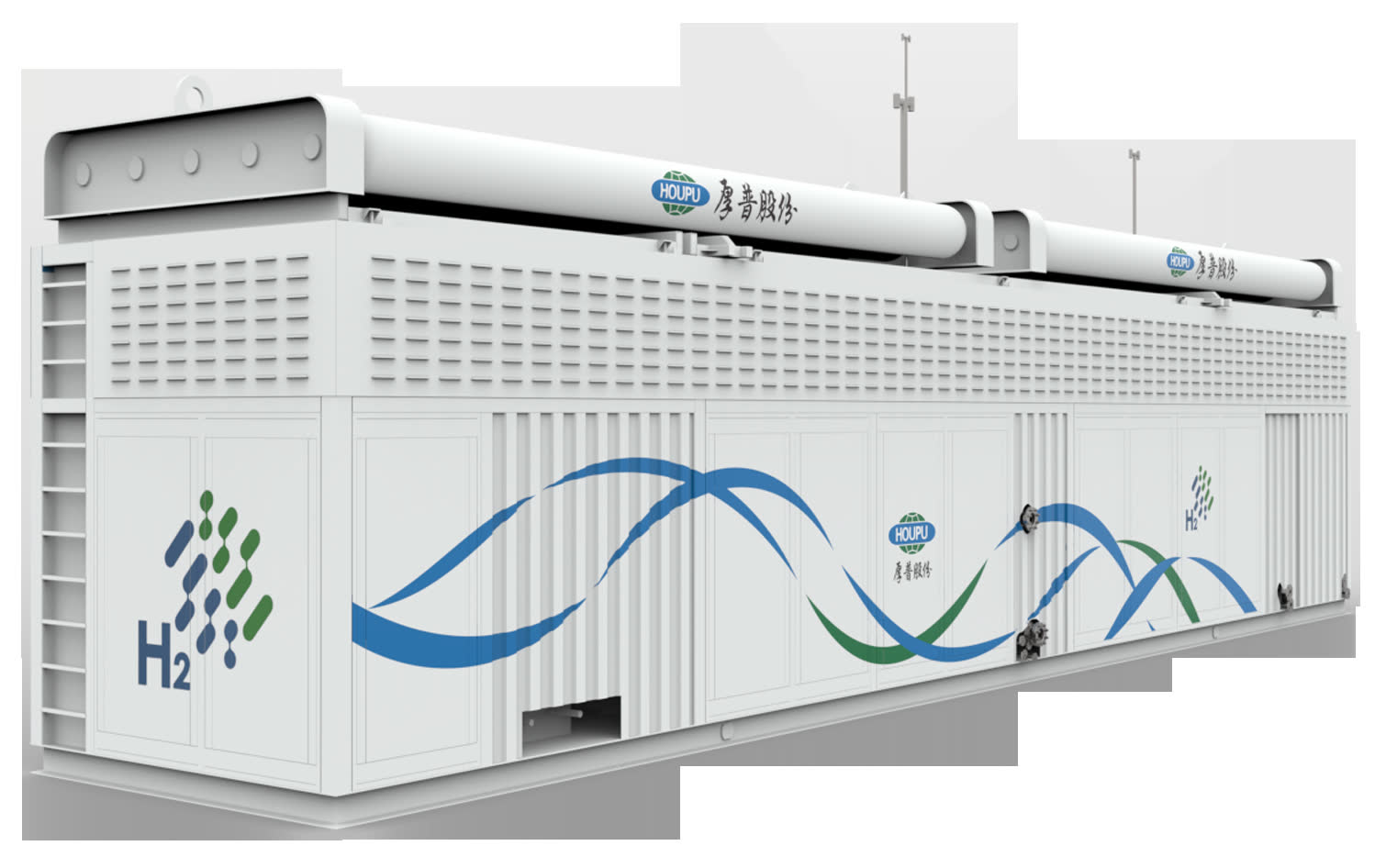
Check 1: Is the Supplier Quoting a Stack or a Complete Hydrogen-Production System?
A thorough procurement evaluation begins by validating battery limits across the entire hydrogen production plant. Sourcing engineers must verify whether an equipment quotation covers only the bare cell stack or includes primary gas-liquid separation, catalytic deoxypurification, power supply rectifiers and electrolyte circulation systems.
Houpu defines its commercial alkaline architecture around five documented functional units: electrolysis, gas-liquid separation, catalytic purification, power supply and alkali circulation. Establishing scope clarity early prevents unexpected integration expenses and ensures clearly defined battery-limit interfaces.
Procurement teams should request comprehensive piping and instrumentation diagrams alongside detailed terminal point schedules during early qualification reviews. This verification ensures that auxiliary piping manifolds, cooling loops and electrical distribution gear are fully accounted for within the project capital budget.
Check 2: Does the Capacity Range Match the Project and Expansion Plan?
Production train sizing must align with immediate facility throughput requirements and future capacity additions. Houpu’s FT-series covers modular production capacities spanning 100 to 1,500 Nm³/h per system, allowing project engineers to evaluate single-train versus multi-train configurations.
Procurement teams must examine turndown limits, common utility pipe headers, transformer sizing and maintenance redundancy. Sizing multiple smaller trains can provide operational flexibility during partial-load renewable generation, whereas a single large electrolyzer train minimizes specific capital investment.
Check 3: Where Are Purity and Pressure Guaranteed?
Procurement specifications must establish whether gas purity is measured at stack discharge or following final drying. Houpu publishes a baseline crude gas purity of 99.8% before purification and 99.999% after catalytic deoxypurification, alongside an adjustable operating pressure of 1.6 MPa.
Sourcing contracts should clarify whether the supplier includes continuous oxygen-in-hydrogen analyzers, moisture dew point sensors and automated safety blow-down valving. Establishing clear analytical acceptance points ensures that fuel-cell grade hydrogen specifications are consistently achieved at the plant battery limit.
In addition, engineers should verify sample line conditioning, calibration gas manifolds and response times of analytical sensors. Automated divert valves should isolate off-spec gas streams instantly, preventing contamination of downstream storage banks.
Check 4: Is the Layout Appropriate for the Site?
Site plot boundaries, transport regulations and civil engineering constraints dictate equipment arrangement. A split layout distributes the cell stack, separation equipment, purification columns and electrical rectifiers across dedicated bays, facilitating maintenance crane access in large-scale plants.
Alternatively, an integrated skid layout combines all functional units onto unified structural frames, minimizing field piping, simplifying foundations and accelerating on-site installation.
Sourcing teams must also verify modular expansion strategies, transport shipping envelopes, lifting lug locations and maintenance corridors around major vessels before finalizing layout selections. Preserving pre-engineered pipe rack headers and electrical tie-in bays accommodates future electrolyzer trains without interrupting active operations.
Proper hazardous area classification governs minimum separation distances between electrical substations, cell stacks and gas purification skids. Sourcing teams must ensure the proposed layout satisfies local ATEX or IECEx zoning regulations without requiring costly civil blast walls.
Check 5: Are Operating Conditions Defined Clearly Enough to Design the Utilities?
Designing site civil and utility infrastructure requires verified thermodynamic data. Houpu specifies an operating thermal baseline of 85±5°C and an adjustable working pressure of 1.6 MPa.
Technical buyers must obtain detailed heat-balance diagrams, deionized water consumption rates, cooling-water flow requirements and electrical harmonic distortion data to properly size peripheral plant utilities.
Demineralized water feed systems require strict conductivity monitoring below 0.1 micro-Siemens per centimeter to preserve stack life. Cooling towers must be sized to reject stack electrochemical heat loads across summer ambient extremes while maintaining steady operating temperatures.
Check 6: Can the Supplier Explain Dynamic Operation at System Level?
Coupling electrolysis with variable renewable energy requires proven dynamic response across the entire balance of plant. Houpu documents single-vessel electrical power tracking from 25% up to full 100% capacity. From a cold shutdown state, the equipment ramps to rated hydrogen production within 30 minutes, whereas hot restarts achieve full flow in 10 seconds when thermal standby systems remain energized.
Buyers should question how auxiliary separation vessels and purification beds respond during rapid electrical ramps, ensuring that gas velocities do not compromise separation efficiency or cause premature drying desiccant degradation.
Evaluating dynamic operation at system level ensures that plant controls manage transient conditions smoothly without triggering nuisance trips or safety venting.
Automated differential pressure control across composite diaphragms prevents gas cross-contamination during steep electrical ramps. System designers should confirm that programmable logic controllers maintain safe oxygen-in-hydrogen thresholds across the entire 25% to 100% operating envelope.
Check 7: Are Installation, Commissioning and Service Boundaries Defined?
Contractual clarity regarding installation supervision, nitrogen purging, hydrostatic testing and performance acceptance testing prevents site disputes. This rigorous quality discipline is reflected in commercial deliveries, where export alkaline electrolyzer packages have completed third-party TÜV inspection before European dispatch. Backed by 138 European CE marks and 494 approved patents, Houpu provides end-to-end engineering support to ensure delivered hardware meets strict international compliance mandates.
Defining lifecycle service responsibilities upfront ensures rapid access to OEM spare parts, remote technical support and scheduled preventive maintenance procedures.
Project agreements should define field engineer deployment schedules, hydrostatic test procedures at design pressure, and site acceptance milestones. Transparent warranty frameworks protect asset availability across initial operational years.
Turn the Checks into an RFQ
Procurement teams can compile these technical checks into a structured tender specification. An effective tender inquiry clearly defines battery limits, specifies required delivery pressure and gas purity at the battery limit, details utility conditions, and mandates transparent factory acceptance testing procedures.
Requiring bidders to document auxiliary power consumption across partial-load regimes ensures transparent operational cost comparisons. Engaging an experienced alkaline electrolyser supplier through a rigorous tender process establishes clear performance accountabilities.
Clear specifications enable procurement teams to score technical submissions objectively, securing equipment that aligns with long-term plant operational goals.
Procurement Takeaway: Qualifying an Alkaline Electrolyser Supplier by Complete System Layout
A successful alkaline electrolyzer procurement program evaluates complete system architecture, layout pragmatism and verified lifecycle support rather than isolated stack metrics. Working with a dependable alkaline electrolyser supplier ensures that production targets, purity standards and safety interlocks are achieved reliably. Houpu’s standardized functional modules and transparent engineering parameters provide a dependable foundation for industrial clean-energy deployment. Project teams can review integrated system configurations at https://www.hqhp-en.com/.
Houpu
Houpu
Legal Disclaimer:
EIN Presswire provides this news content "as is" without warranty of any kind. We do not accept any responsibility or liability for the accuracy, content, images, videos, licenses, completeness, legality, or reliability of the information contained in this article. If you have any complaints or copyright issues related to this article, kindly contact the author above.
