

Shufti Recognised Among Top Performers in DHS 2025 Remote Identity Validation Rally
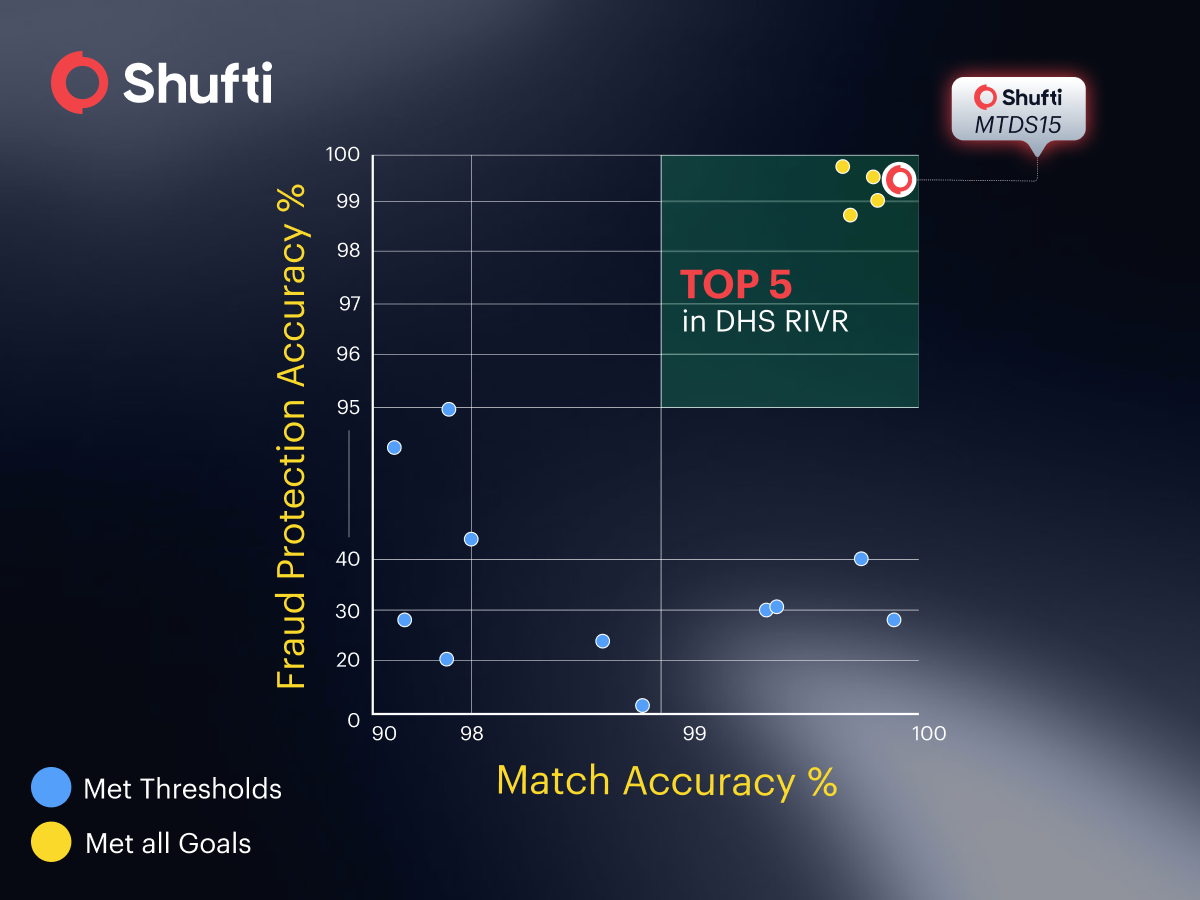
Shufti ranked a top performer in the 2025 U.S. DHS Remote Identity Validation Rally, meeting all goals in the Selfie Match to Document evaluation.
LONDON, UNITED KINGDOM, March 30, 2026 /EINPresswire.com/ -- Shufti, a global identity verification and fraud prevention provider, has been recognised as a top performer in the published results of the U.S. Department of Homeland Security Science and Technology Directorate’s 2025 Remote Identity Validation Rally (RIVR), an independent government-led evaluation of remote identity verification technologies. The results place Shufti among a limited group of vendors whose systems met all defined performance goals in the Selfie Match to Document (SMTD) track.
The Remote Identity Validation Rally is designed to assess commercial identity verification systems under standardised and independently controlled conditions. The recognition follows Shufti’s participation in Phase 1 of the rally, known as the Selfie Match to Document (SMTD) evaluation.
This phase, the SMTD evaluation, examines whether a live selfie can be accurately matched to the photograph on a genuine U.S. state-issued identity document. The Testing is conducted by the Maryland Test Facility using consistent devices, datasets, and ISO-aligned biometric performance metrics to enable objective comparison across vendors.
Shufti’s system, evaluated under the alias MTDS 15, was one of five out of sixteen participating systems to achieve goal-level performance across all SMTD metrics. The evaluation framework measures Failure to Extract Rate (FTXR), False Non-Match Rate (FNMR), and False Match Rate (FMR), with results reported on a worst-case basis to reflect deployment risk rather than best-case laboratory outcomes.
Systems are tested across multiple smartphones and issuing states, and results are reported using a worst-case methodology to reflect real-world deployment risk rather than best-case laboratory performance.
What Was Tested and What It Showed
According to the official SMTD results summary, Shufti’s system (MTDS 15) achieved:
-Zero selfie extraction failures, indicating consistent biometric template generation across all tested devices
-Zero document extraction failures across all tested smartphones and issuing-state combinations
-A worst-case FNMR below 0.68%, remaining within goal thresholds under the most challenging evaluated conditions
-A false match rate below 0.01% in non-mated comparison testing
-Goal-level performance status across all reported SMTD metrics
The official results further show that only 31% of evaluated systems achieved goal-level performance across every SMTD metric. This distribution underscores the impact of independent, standardised testing in distinguishing systems that maintain performance consistency across devices and conditions.
Why This Matters for Regulated Onboarding
Selfie-to-document matching remains a core control within remote onboarding workflows, particularly in regulated sectors such as financial services and fintech. Performance at this stage influences customer completion rates, operational efficiency, and compliance risk. By emphasising extraction reliability and worst-case reporting, the RIVR methodology aligns testing conditions with the operational realities organisations face in live environments.
Commenting on the results, Shahid Hanif, Chief Executive Officer of Shufti, stated:
“The value of RIVR lies in its methodology. Systems are evaluated using consistent devices, standardised datasets, and ISO-aligned metrics, with results reported on a worst-case basis. Being among the systems that met all SMTD performance goals reflects our focus on reliability and consistency under independent assessment.”
Shufti’s performance in the 2025 RIVR SMTD evaluation demonstrates measured outcomes across extraction stability, false match control, and low rejection of legitimate users. These attributes are critical for organisations operating at scale in compliance-driven environments, where both identity assurance and user experience must be sustained.
The full SMTD results summary is published by the Maryland Test Facility as part of the DHS Science and Technology Directorate’s 2025 Remote Identity Validation Rally programme.
To learn more, visit Shufti or contact the team for details.
About Shufti
Shufti is a global provider of identity verification and compliance technology, helping businesses securely onboard customers while meeting regulatory obligations. Its fully in-house solution that combines human-assisted and AI-driven verification, document authentication, biometric matching, and AML screening to deliver high-assurance, audit-ready results.
It helps organizations manage risk, prevent fraud, and maintain compliance across multiple jurisdictions, supporting operational efficiency and supervisory accountability. Its solutions serve regulated sectors including finance, payments, crypto, and insurance.
SOURCE SHUFTI
Neliswa Mncube
Shufti
partnership@shuftipro.com
Visit us on social media:
LinkedIn
Bluesky
Instagram
YouTube
TikTok
X
IDV Vendor Evaluation for Enterprises
Legal Disclaimer:
EIN Presswire provides this news content "as is" without warranty of any kind. We do not accept any responsibility or liability for the accuracy, content, images, videos, licenses, completeness, legality, or reliability of the information contained in this article. If you have any complaints or copyright issues related to this article, kindly contact the author above.
